Before watching the film recently, I’d heard a lot about Paris is Burning. It has been heralded, in my experience, as a film that you need to watch if you are a part of or studying the LGBTQ+ community. It was ground-breaking, it is part of the reason drag grew to what it is today, and it’s a part of our history. It wasn’t until I watched the movie and dived into the discourse that I began to understand just how controversial this movie was.
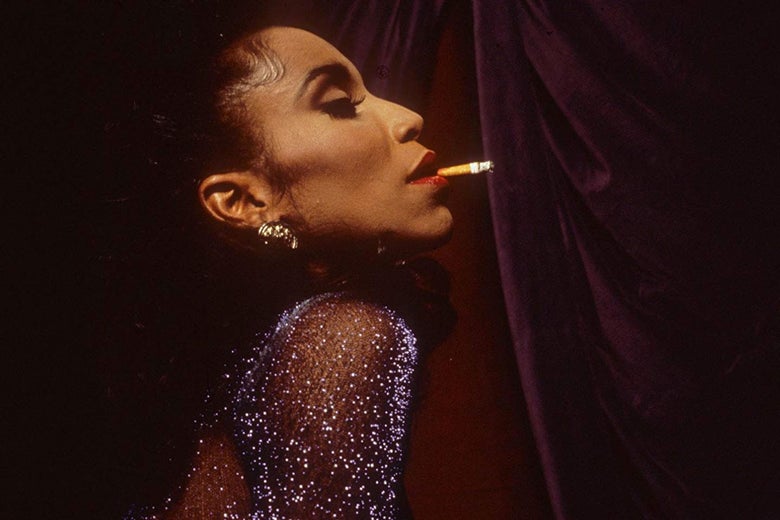
There is always a controversy, it seems, with films that break boundaries. It does too much, or not enough. The issue with being one of the first films to do something is that there is such a high level of expectation placed upon them. They’re expected to be perfect, so that no one can look at these issues and see them in a bad light. But at the same time, while they’re supposed to show issues in good light, they are also expected to show the complexities in them. Jennie Livingston was in a position where she wouldn’t win everyone. Of course, there are issues that revolve around how she treated the subjects of her film and how she compensated them, but that is not something I wish to discuss here. Instead I want to look into the film itself, and it’s contents.
“In the drag ball realness, we witness and produce the phantasmatic constitution of a subject, a subject who repeats and mimes the legitimating norms by which it itself has been dregraded, a subject founded in the project of mastery that compels and disrupts its own repetitions” (Butler 343)
Judith Butler is one of the scholars that is easy to go to when it comes to complicated answers in gender and sexuality, and the complexities in Paris is Burning is no exception. In a sentence, Butler captures what I believe is some of the criticisms with Paris is Burning and even drag as a whole. On the surface, it appears that they hold up these societal standards that degrade the LGBTQ+ community. They celebrate hyper femininity and masculinity, and they celebrate the idea of “passing” in a straight, cis world. However, in celebrating this they are also acknowledging that to get high up in our society you need to abide by these societal standards.
Paris is Burning shows this juxtaposition without directly addressing it. The film was not made to question the societal standards of our world, but rather it was made to document the lives of people who perform drag. Drag itself, as Bulter suggests, is a complicated layering of both celebrating and calling out societal standards. Butler argues that, “there is no necessary relation between drag and subversion, and that drag may well be used in the service of both the denaturalization and reidealization of hyperbolic heterosexual gender norms” (Butler 338). What she is arguing is that drag can be used to subvert our expectations. It can be used to call out the standards that make it impossible for some people to survive. However, it can also be used to idealize the standards that put people down. Paris is Burning shows both sides of that and doesn’t pick a side, which emphasizes the complexity in drag itself. There are some like Cesar Valentino, who use drag to subvert expectations of men and who rose to notoriety despite the fact that he didn’t fit in with society’s expectations. There are others like Octavia St Laurent who wanted to be a model and fit in with societal expectations of a model (seen in the clip below). And then still there is Venus Xtravaganza who, like St Laurent, was trying to fit into the societal standards of a woman and was killed because she didn’t.
Daniel T. Contreras addressed a similar issue of idealization within the concept of race in Paris is Burning. There were some who argued that views like St Laurent’s in the above clip were damaging. As Contreras argues against this, explaining that, “The wish to be ‘white’, seems in this case, not simply a psychological pathology, but also a sense of not wanting to be what one is – poor, abject” (Contreras 126).
Much like the issue with gender in Paris is Burning (and drag as a whole), there is a question of the representation of race. St Laurent’s desire to be like the white models she sees in magazines could be seen as degrading towards people of color and only putting the group in charge in more power. However, at the same time it calls to attention the fact that there’s no women like her in modelling. Under the right view, there is the question ‘why does she have to look up to white models?’
That, as a whole, is what I saw at play in Paris is Burning. Bulter had the subheading “Ambivalent Drag” (338), and that captures what some of the largest critiques of the film come from. Livingston did not make the film to make a stance on how drag should be used or perceived. She didn’t make a stand on whether drag should be subverting or idealizing societal standards, or whether people of color should be striving to be like their white counterparts. She simply showed the stories of some of the people in the New York drag scene. While some may criticize her for not taking a stronger stand on the issues, there is an importance to showing the real life examples and letting an audience decide for themselves what they think.
Butler, Judith. “Gender is Burning: Questions of Appropriation and Subversion.” Feminist Film Theory: A Reader, edited by Sue Thornham, New York University Press, 1999, pp. 336-349
Contreras, Daniel T. “New Queer Cinema: Spectacle, Race, Utopia.” New Queer Cinema: A Critical Reader, edited by Michele Aaron, Rutgers University Press, 2004, pp. 119-127
Paris Is Burning. Directed by Jennie Livingston, staring Brooke Xtravaganza, Venus Xtravaganza, and Dorian Corey, Art Matters Inc. & BBC Television, 1991.

 Gender & Sexuality in Film