The Body Remembers when the World Broke Open premiered in 2019 at the Berlin Film Festival as well as the Toronto International Film Festival. It follows the day Áila (Elle Máijá Tailfeathers) meets Rosie (Violet Nelson). Rosie has just left her boyfriend’s house after encountering domestic abuse when Áila finds her. Áila takes Rosie under her wing and attempts to get her the help she and her unborn baby need. In an interview with Vogue, Tailfeathers admits that the movie is based on an encounter she personally had and Nelson claims to have drawn from her mother (who suffered domestic abuse) for the role (Sullivan).
The film itself is almost nearly one long shot, most of which is a close up on one of the two women. Tailfeather explains that, “I wanted to make a film that would happen in real time, so that we have just the simple, short experience that these two strangers had together, and then we’d leave it where we leave it, so that the audience would walk away with the same feelings that probably the young woman and I were left with” (Sullivan). However, there’s more to be said about the camera movement itself than the life-like effect it gives.
Paul Schader explains the difference between motivated and unmotivated camera movement. Motivated is a movement that follows the on screen subjects (the subject moves, and so does the camera), while unmotivated is a movement based on creating an emphasis. The Body Remembers, by staying almost entirely in close ups, relies on motivated camera movement. While praising unmotivated camera movement, Schader explains that it constantly shifts the plane of focus. Therefore, by staying in motivated movement, The Body Remembers keeps focus on the females who are telling the story. The technique in which the film was shot forces the audience to keep their attention on the women telling the story. It demands the attention of the story be on the two women and what they are telling us.
Moreover, as Tailfeather said, it focuses on a real time event. Long pauses in dialogue allow the audience to focus in on how the actresses are looking – what faces they are making and what they are saying without words. Even within the film, Áila and Rosie are able to communicate without speaking. In one dialogue Rosie tells Áila that Áila isn’t better than her, and when Áila insists she didn’t say that, Rosie argues, “You didn’t need to.” The audience doesn’t need to hear them say words either. Rosie’s pregnancy doesn’t need to be announced for the audience or for Áila to pick up on it.
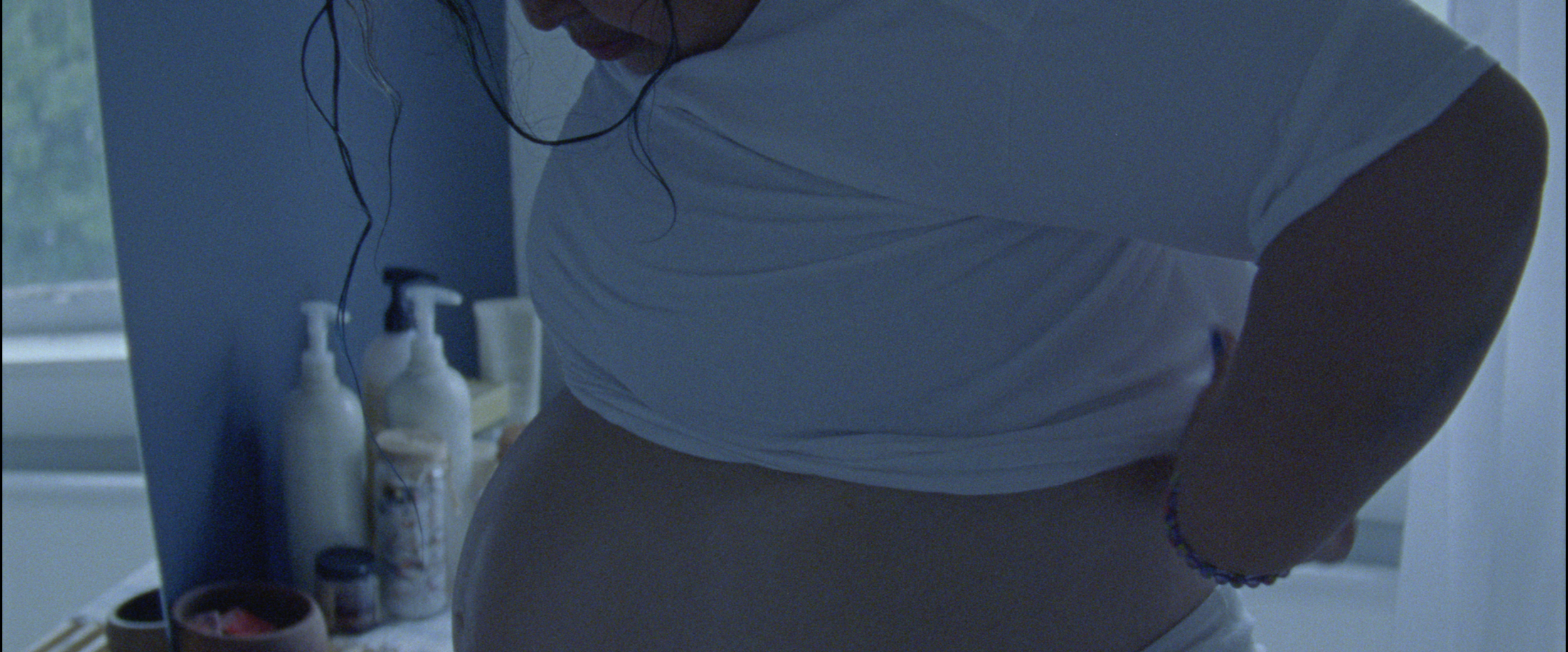
This continuous shot, motivated camera movement, and lack of dialogue to communicate ideas put the audience in the shoes of the women on the screen. Motivations for both women are clearly laid out without it ever having to be fully explained. Tailfeather and Hepburn took the story and inputted the audiences into it. It gives the audience something to walk away and think about.
But at the same time, this is only a brief glimpse into these women’s lives, and it leaves the audiences with the characters progressing very little. When Rosie leaves the Safe House, Sofie tells Áila that it’s just the first step for Rosie, and that’s what this film is. It’s a first step for both of these women.
Rosie is in an abusive relationship, debating what is best for her unborn child and herself. Áila is just coming from a doctor’s appointment to implant a IUD to keep herself from getting pregnant. Neither of them know what to do at the end of the film but have only just started thinking about what is to come. While this may be unsavory for some viewers, it does a good job of making the audience think. By leaving the story with Rosie walking away and Áila not stopping her, it makes the audience question what these women do after but also what they would do in the situation. It further makes the audience part of the subject.
The Body Remembers when the World Broke Open. Directed by Kathleen Hepburn and Elle Máijá Tailfeathers, performances by Violet Nelson and Máijá Tailfeathers, Experimental Forest Films, 2019.
Sullivan, Robert. “In The Body Remembers When the World Broke Open, Two Women Grapple With Trauma and the Past” Vogue, 5 Dec 2019, https://www.vogue.com/article/the-body-remembers-when-the-world-broke-open-interview
Schader, Paul, and Robert Brink. “Camera Movement: Part IV.” Film Comment, vol. 51, no. 2, 2015, pp. 56–61., http://www.jstor.org/stable/43746067.
Rosie’s Stomach Image. “The Body Remembers when the World Broke Open.” Q-Films. http://www.q-films.com/the-body-remembers-when-the-world-broke-open

 Gender & Sexuality in Film
I found your discussion of the camerawork in the film to be really insightful, and I agree that the pauses in the film are so revealing and meaningful as well. It’s interesting that so many viewers seem to have a negative reaction to both these aspects of the film, and I wonder if that negative reaction, in addition to being about viewers accustomed to Hollywood style pace, editing, and camerawork, is also about gender, that in some ways this film is embodying women’s concerns and “women’s time” both in terms of form and content, and that viewers aren’t used to this and may even find it discomforting? After all, how many Hollywood films push men to the periphery of the action (figuratively and literally) in the same way that The Body Remembers does?
LikeLike